Thursday, 4 February 2021

Battle of Sinsheim 1674 Part 2

 Some more pictures of the Battle of Sinsheim 1674:

The French Asfeld Dragoons have rushed the bridge in column; the Dutch Marwitz Dragoons try to hold them off with a volley.

The French dragoons about to charge their Dutch opposites, urged on by a French general (Turenne himself, perhaps?)

The French column along the road to the bridge,
with the first of their cavalry regiments appearing on the battlefield.

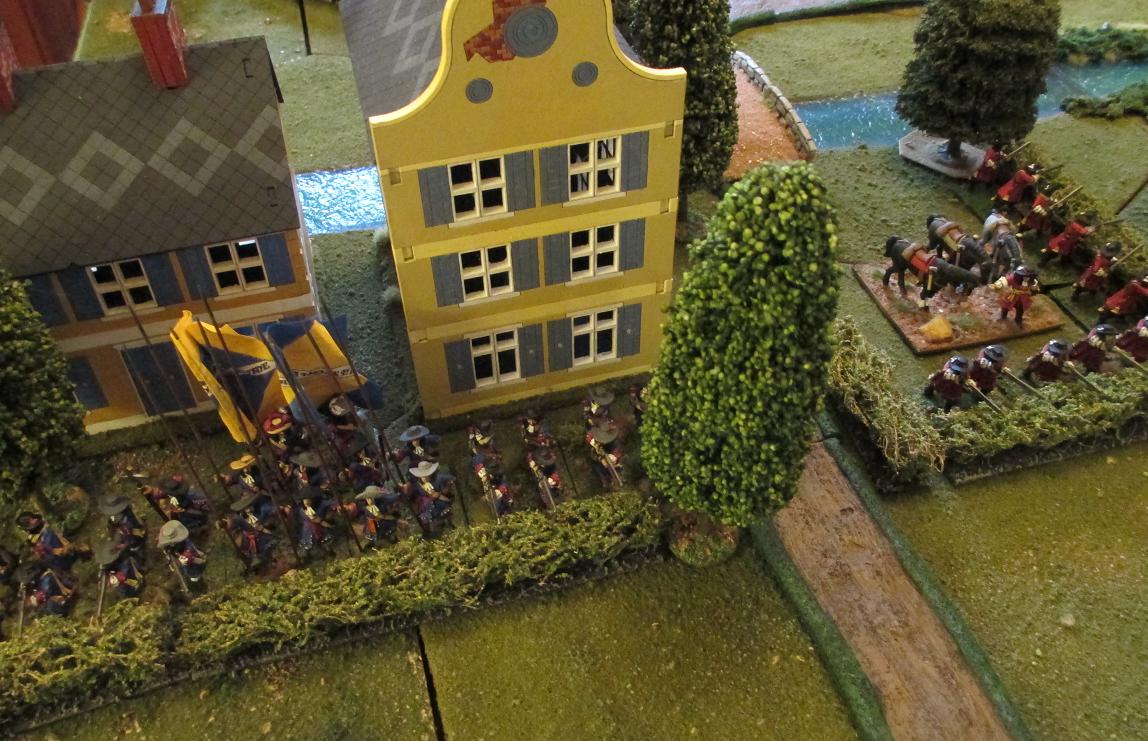
The French Condé Regiment of Foot marches up the left hand defile, past the single house,
towards the Allied right wing cavalry.

Squadrons of French light horse regiments moving along the road to the bridge.


The Asfeld Dragoons have driven off their Dutch opponents and La Fère Regiment of Foot moves off towards the right flank behind them.

Condé Regiment of Foot secures the hedges along the edge of the plateau; The Dutch Hoornbergh Light Horse Regiment can do little to prevent it.

The view from the French infantry's side: Allied cavalry regiments lined up on the plateau.

The French Asfeld Dragoons have moved up onto the plateau to support the French cavalry as it moves up the central defile to deploy. This triggered a reaction by the Allies - the Bamberg Cuirassier Regiment advanced to the attack.


The Dutch Waldeck Light Horse Regiment advances as well.

The French cavalry column crossing the bridge.

A wider view of the battlefield as the Allied cavalry respond to the arrival of the
French troops on the edge of the plateau.

Another view of the French cavalry column on the road to the bridge:
Villeroi Light Horse Regiment is in the foreground of the picture.

La Fère Regiment of Foot moving to the right along the river road.

A view of the French cavalry moving up to the plateau and to the right.

The Allied cavalry move forward, except in the background,
where they have retired out of range of the French infantry's muskets.

The Asfeld Dragoons stand to meet the Bamberg Cuirassiers attack, while in the background the Dauphin Light Horse Regiment charges their opponents. The French dragoons, unsurprisingly, were completely defeated by the Austrian cavalry and fled the field!

The French Royal Cravattes Light Horse Regiment. Their unusual name is a corruption of "Croats", a unit of which had served with the French army earlier in the 17th Century.

La Reine Light Horse Regiment, the only French "Royal" line cavalry unit to wear red coats with blue facings; the others wore blue coats with red facings.

Dauphin against Bamberg. Under the "fast play" rules I use, Cuirassiers operate in big squadrons of twelve figures, while Light Horse Regiments operate in squadrons of six figures. It represents well the solid mass of Imperial units which the French had to deal with by "wave attacks" involving charges by one squadron after another,

More pictures to follow...

Tuesday, 2 February 2021

Battle of Sinsheim 1674 Part 1

The Battle of Sinsheim 1674. I played this solo (life being as it is at the moment!), taking the role of the French under Turenne and the Allies being the "other" side, controlled in their actions by dice/cards and certain actions by the French. I am not sure how well it would work with opposing players, as a "real" Allied player would probably be more proactive than the Allied commanders at the time, Caprara and Lorraine. Anyway, the played very similar to the actual battle and I think that the Allies could win it, especially if they held on to Sinsheim for a long time and exhausted the French infantry, while their cavalry, especially the Cuirassier Regiments, are very tough to beat and could stop the French horse units developing a position on the plateau. I do not have enough Austrian/Imperial figures for the Allies, so I used my Dutch as well.

The battlefield. I played along the length of my 6 foot by 4 foot table. Sinsheim is to the left with its hedges and bridge over the river; the lone house further up represent the old castle, and the Allied cavalry is deployed on the plateau, with hedges along the edges of the defiles and slopes. I have simplified the actual battle's terrain to what i thought were the key features.

The Dutch Nassau-Friesland Regiment of Foot holding Sinsheim.
The houses are Sarissa models, made and painted by my wargame's colleague, Steve
(see his blog Tunnie's Terrain, for his lovely figures and models).

The Allied cavalry on the plateau. Light Horse on the flanks, Cuirassier units in the centre.

The Dutch Waldeck Light Horse Regiment (two squadrons).

The Austrian Bamberg Cuirassier Regiment (two big squadrons).

The Austrian Caprara Cuirassier Regiment (two big squadrons).

The Dutch Berlo and Hoornbergh Light Horse Regiments (two squadrons each).

Berlo on the left and Hoornbergh on the right.

The Allied cavalry line from the opposite end.

A view of the left hand defile, house and hedges, with the Allied cavalry waiting beyond. The line of trees at the back was "aesthetic", representing the wood the Allies eventually retired through in the actual battle.

Bamberg Cuirassier to the left, Caprara Cuirassier to the right. The Austrian cavalry at this time was almost entirely made up of Cuirassier Regiments and the French found them very difficult to beat.

The Dutch Marwitz Dragoon Regiment holding the hedges at Sinsheim.
The figures in the pictures are from the North Star 1672 range (ex-Copplestone Castings), plus a few from the League of Augsburg Range produced by Warfare Miniatures. The flags are from the latter as well, Maverick Models or homemade.

Sinsheim and its defenders.

The Allied baggage train.

The river and bridge. The river Elsenz was impassable except at Sinsheim. The terrain tiles I use were bought some years ago from a wargames club who had used them for 1/300 scale battles. They were very battered but Steve kindly improved them to the excellent standard you can see in the pictures.

The French Guiche Regiment of Foot. Unusual amongst French infantry units for its yellow facings.

The French attack on Sinsheim develops. Guiche on the left; Asfeld Dragoon Regiment on the right, fighting dismounted. Dragoons by this date had flintlock muskets and fought in thinner formations than the normal foot regiments with their matchlock muskets.

The Guiche Regiment masses for a charge against the defenders of Sinsheim. Units would close up their files for close combat, which usually halved the frontage they would use for musketry.

Asfeld Dragoons exchange fire with the Dutch dragoons behind the hedges, while the French Condé Regiment of Foot moved up in support.

Condé Regiment pass through the Asfeld Dragoons and attack the Dutch dragoons.

The French artillery moves up. Sinsheim was a fine example of combined arms action by the French under Turenne, which contributed significantly to their victory.

Condé Regiment has bundled the Dutch dragoons out of their position and towards the bridge.

The Marwitz Dragoons rallied to hold the crossing and Condé Regiment opens fire.

More to follow...