Sunday, 16 January 2022

15mm Thirty Years War Campaign

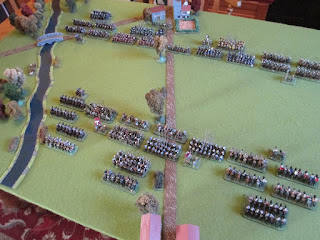
I decided to start off this year with a mini-campaign based on the Thirty Years War using my 15mm collection of 17th figures. I drew up a map, based on the Holy Roman Empire, allowing movement between regions/states, with battles being fought when opposing sides clash in the same region/state. I will post a copy of the map for anyone to use as well as the basic rules in the future. Suffice to say I have managed two games already! They each had about twenty units per side, played using a set of rules downloaded off the Web many years ago. The figures are a mixture of Essex, Mikes Models and unknowns, with many painted over forty years ago (apologies for the quality!) and others purchased at shows or online. I base them as whole units - foot regiments, shot battalions, artillery batteries, cavalry squadrons, with separate command bases. I do not give the units flags/standards/ensigns, so I can use them for any side. Purists will note that I have far too many light horse and too few cuirassiers, but that is a consequence of how my collection and purchases unfolded over the years, as well as my knowledge of the war. The flags on the foot command bases are fictional, but they do for me! Anyway, here are some images of the first battle: Spanish vs. Dutch in theory, fighting to control Jülich. The game ended in a draw and both sides withdrew.

The battlefield - a four feet by three feet table. Houses are homemade from match boxes, card and paper (originally for ECW, hence the 'mock-Tudor look'!); trees are homemade from twigs and lichen; bridge, road and river are all commercial, although I no longer remember the manufacturers.

The opposing forces deployed for battle: Spanish nearest to, Dutch furthest from the camera.

Mounted command base to the front of a brigade of cavalry squadrons.
Light horse are in single rank squadrons.

Cuirassiers are mounted in large squadrons.
Foot regiments with muskets on the flanks of pikemen (30 figures in all), with medium and light guns in front, two model pieces per base.


Under the rules, units fight and shoot as a whole formation, the number of figures is not that important, but I think 15mm look best en masse.


The red counter indicates the unit has lost a 'level'.

A wider view of the battlefield.
The white counter indicates the unit is now down three levels, being 'disordered'.
Artillery and musketry, as well as hand-to-hand combat, is resolved by a single 10-sided dice,
with plus and minus factors.


The black counter indicates the unit has lost two levels and is now 'unsteady.'
The cavalry battles on each wing proved to be see-saw affairs, with many charges and counter-charges and no decisive breakthrough until towards the end of the game on the Spanish right wing.


The end of the game, with the Spanish outflanking the Dutch lines in the foreground, but with the former's infantry and artillery under pressure at the top from the latter's cavalry.

For this battle, the Spanish side had:

                        One Cuirassier Squadron

                        Eight Horse Squadrons

                        One Dragoon Squadron

                        Five Foot Regiments

                        One Medium Gun Battery

                        One Light Gun Battery

                        Four Generals (Two Mounted, Two Foot)                       

The Dutch side had:

                        One Cuirassier Squadron

                        Eight Horse Squadrons

                        One Dragoon Squadron

                        Six Foot Regiments

                        One Medium Gun Battery

                        Four Generals (Two Mounted, Two Foot)   

Second battle to follow...

Sunday, 2 January 2022

Sun King Cavalry Regiment.

And last, but by no means least, a French horse regiment for my Sun King 1670s collection - Colonel-Général, which was formerly Turenne's regiment of cavalry. He held the office of Colonel-Général of Horse under Louis XIV and on his death in 1675 the regiment took that title. The uniform is a grey coat with black cuffs and extras. There are several variants of the unit flag available commercially: these are from Maverick Models. The white tower on the flag is from Turenne's coat of arms. I tend to give my horse regiments a variety of colours for their mounts in the belief that the rigours of campaigning would soon lead to replacements of all shapes and sizes appearing in the ranks. I have done the trumpeter in reverse colours and on a white horse, although I do not know if the latter was common at the time. As ever, the figures are 28mm metal North Star 1672 (ex-Copplestone Castings).